Vision-Language-Action (VLA) models commonly predict action chunks, limiting their ability to react to environmental changes during execution. Existing asynchronous inference methods improve reactivity but typically rely on a fixed inference gap. In this paper, we propose an event-guided dynamic inference strategy that adapts the inference gap according to scene changes observed since the previous inference. This allows it to preserve motion consistency while responding promptly to environmental changes. Across static and dynamic real-world settings, our method consistently performs best, averaging 95% success and exceeding the strongest baseline by 55 percentage points. The code will be made publicly available upon acceptance.
The method, in motion
02:58 · Real-world robot experiments
The compiled film labels obstacle-task playback at 2× and moving-target playback at 1×. Individual clips below retain the timing of the supplied videos.
Action chunks keep a robot moving. But the world can change before a chunk finishes.
A fixed inference gap creates a trade-off: longer gaps preserve uninterrupted motion, while shorter gaps bring in fresh observations more often. Frequent transitions, however, can disturb the precise movements needed for grasping.
We adapt inference timing to visual events, keeping a long gap in stable scenes and triggering an earlier update when the scene changes.
Long inference gap
Consistent motion
Fewer chunk transitions. Slower response to unexpected changes.
Short inference gap
Frequent updates
More recent observations. More transitions during precise manipulation.
Our approach
React to the scene
A long gap by default. An earlier update when an event is detected.
02 / The method
A second look. At the right moment.
Compare the current observation with the scene used to predict the active action chunk.
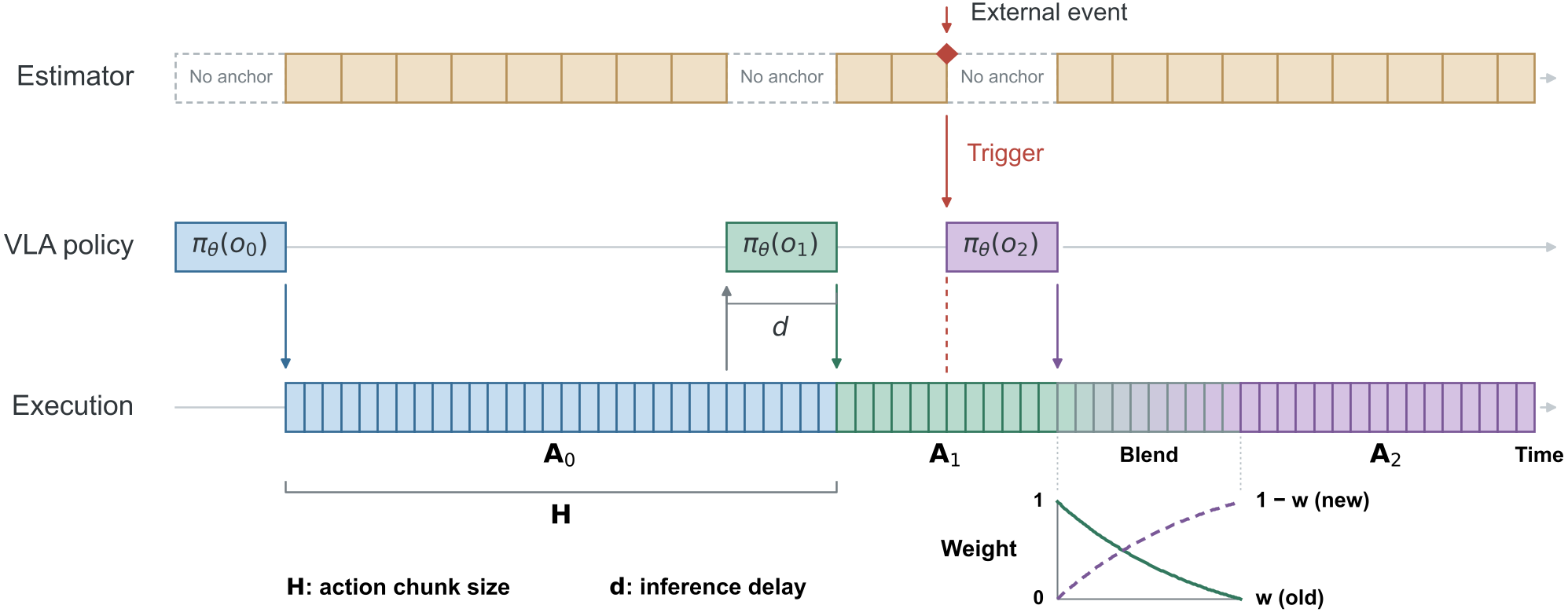
Policy inference and event estimation alternate while the robot executes actions. An event advances the next policy update. See paper Figure 1. Select the diagram to view it at full resolution.
01
Observe a pair
A lightweight decoder compares visual features from the anchor observation and the latest camera observation. No event labels are annotated by hand: supervision is constructed automatically from human demonstrations, using the divergence between the reference policy’s predicted actions and demonstrated actions as a continuous event score. Details in the paper: §IV-A–B ↗
02
Detect a persistent change
Trigger early inference after two consecutive estimates exceed the event threshold. Otherwise, start the next inference after H − d actions have executed, leaving d actions to cover the inference delay. The paper defines its threshold from the 90th percentile of static-demonstration scores. Details in the paper: §IV-B ↗
03
Blend the next action chunk
When the updated chunk arrives, blend the overlapping actions. The old chunk’s weight decreases from 1 to 0 as the new chunk takes over.
Smooth transition · Paper equations 8–9
Amerge = w Aold + (1 − w) Anew
The event score is an action-discrepancy proxy. It is not a collision probability or a safety guarantee.
Training and execution details +
Learning the event signal
For each task, the paper uses 40 static and 160 dynamic demonstrations. The π₀.₅ policy is fine-tuned on the static subset; anchor–current observation pairs from the combined dataset supervise the event estimator.
Reported execution setup
Franka Emika Panda, three RGB camera views, a 50-action horizon, 30 Hz execution, and 15 Hz event estimation. The paper reports a five-action inference delay for methods other than RTC and a blending decay β = 1.2.
These are the study settings reported in the paper (§IV–V), rather than measurements made by this webpage.
03 / Compared methods
One policy. Different update strategies.
All configurations use the same π₀.₅ backbone. The fixed-gap ablations disable event estimation and retain the remaining execution components.
01
Synchronous
Policy inference and action execution alternate, without overlap.
02
DynamicVLA
Discard actions whose intended execution steps elapse during inference, then update the buffer with the remaining chunk.
03
RTC
Condition new chunks on committed actions using inference-time inpainting and soft masking.
04
Fixed-gap
Schedule updates at g ∈ {0, 5, 25, 45}. The event estimator is disabled.
04 / Real-world evaluation
Stable when it can be. Responsive when it needs to be.
Three settings separate precise manipulation, obstacle response, and adaptation to a moving target.
Experiment 01
Stable scenes. Steady execution.
The obstacle remains stationary during transport. The robot must pick up the blue cube, carry it around the obstacle, and place it on the green plate.
100%20 / 20 full-task trials
Choose a video case
Filter by method, then select a case to watch.
OursSelected demonstration
Full-task successPick, transport around the static obstacle, and place. Includes the recorded inference-gap trace.Download this case ↓
Paper §VI-A, Table II(a)
Preserving the grasp
Frequent chunk transitions can disrupt precise gripper–object alignment. Here, the event-triggered method preserves a long inference gap when no significant change is detected, matching synchronous execution and the long-gap ablations.
A successful pick, obstacle avoidance, and placement in one continuous trial.
Stage-wise and full-task success · 20 trials per method
Method
Pick
Avoidance
Place
Full task
Synchronous
100%
100%
100%
100%
DynamicVLA
0%
100%
90%
0%
RTC
0%
100%
100%
0%
Fixed-gap (g = 0)
0%
100%
100%
0%
Fixed-gap (g = 5)
30%
100%
100%
30%
Fixed-gap (g = 25)
100%
100%
100%
100%
Fixed-gap (g = 45)
100%
100%
100%
100%
Ours
100%
100%
100%
100%
Experiment 02
The scene changes. The robot reacts.
During transport, a human operator repeatedly places a hand in the robot’s current path. After each avoidance response, the hand is repositioned to obstruct the updated path.
100%20 / 20 full-task trials
Choose a video case
Filter by method, then select a case to watch.
OursSelected demonstration
Obstacle avoidanceRepeated obstruction and avoidance, with the recorded inference-gap trace.Download this case ↓
Paper §VI-B.1, Table II(b)
Reacting during transport
The event estimator monitors the current scene against the observation used for the active chunk. A persistent change triggers an earlier policy update, allowing another avoidance response while retaining reliable grasping.
Short-gap baselines can avoid obstacles yet still fail the full task because of grasping failures.
Stage-wise and full-task success · 20 trials per method
Method
Pick
Avoidance
Place
Full task
Synchronous
100%
0%
100%
0%
DynamicVLA
0%
0%
100%
0%
RTC
15%
95%
100%
15%
Fixed-gap (g = 0)
0%
95%
100%
0%
Fixed-gap (g = 5)
15%
90%
100%
15%
Fixed-gap (g = 25)
90%
0%
95%
0%
Fixed-gap (g = 45)
100%
0%
100%
0%
Ours
100%
100%
100%
100%
Experiment 03
A moving target. A new placement plan.
The robot starts with the object already grasped. As the object approaches the plate, the operator moves the plate away and changes its direction, requiring repeated placement updates.
85%17 / 20 placement trials
Choose a video case
Filter by method, then select a case to watch.
OursSelected demonstration
Successful placementSuccessful placement onto the moving plate, with the recorded inference-gap trace.Download this case ↓
Paper §VI-B.2, Figures 4, 6–7
Updating the intended destination
A long gap can leave the robot following a placement trajectory toward the previous plate position. Event-triggered updates adapt the action sequence to the relocated target; simply inferring as often as possible is not sufficient.
The best fixed-gap ablation reaches 60%; RTC reaches 40% in this setting.
Synchronous
5%
DynamicVLA
0%
RTC
40%
Fixed-gap (g = 0)
30%
Fixed-gap (g = 5)
60%
Fixed-gap (g = 25)
20%
Fixed-gap (g = 45)
15%
Ours
85%
05 / Overall performance
The advantage holds across settings.
The event-triggered method reaches 100%, 100%, and 85% success. The equally weighted mean is 95%, compared with 40% for the strongest fixed-gap ablation.
Full-task success by setting · Paper Tables II(a–b), Figures 6 and 8
Method
Static obstacle
Dynamic obstacle
Moving target
Mean
Synchronous
100%
0%
5%
35%
DynamicVLA
0%
0%
0%
0%
RTC
0%
15%
40%
18%
Fixed-gap (g = 0)
0%
0%
30%
10%
Fixed-gap (g = 5)
30%
15%
60%
35%
Fixed-gap (g = 25)
100%
0%
20%
40%
Fixed-gap (g = 45)
100%
0%
15%
38%
Ours
100%
100%
85%
95%
Mean = (static-obstacle + dynamic-obstacle + moving-target success) / 3, rounded to the nearest whole percent. The paper’s Figure 8 shows their sum on a 0–300 scale; this table shows the equivalent mean on a 0–100% scale. Results describe the evaluated tasks and configurations.
Explore the work
Paper, film, and demonstrations.
Anonymous supplementary material for an ICRA submission. Code will be made publicly available upon acceptance.